defensive technique
also: technique numbers · alignment numbers · 2i · 4i · shade
The numbering system for where a defensive lineman stands relative to an offensive lineman. Even numbers are head up, odd numbers are a shoulder, and an i means the inside shoulder.
defensive technique, the numbering system
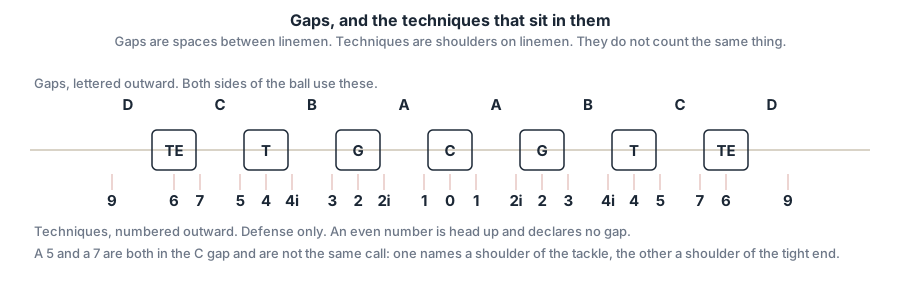
A scale counted outward from the center: 0 is head up on the center, 2 head up on the guard, 4 head up on the tackle, 6 head up on the tight end. Odd numbers are outside shoulders, so 1 is a shade of the center, 3 the guard's outside shoulder, 5 the tackle's outside shoulder, 9 wide outside the tight end. An i suffix means the inside shoulder instead, which is why 4i sits inside the tackle and 2i inside the guard. Seven is the tight end's inside shoulder, and eight is not used.
The scale names a MAN and a SHOULDER. Gap letters name a SPACE. That is the whole difference. It is why a three technique and the B gap point at almost the same ground without being the same statement.
technique numbers, alignment numbersgap letters, hole numbers, receiver numbersReference
Techniques are shoulders ON linemen, numbered outward. Defense only. Even is head up, odd is a shoulder, and an i moves an even number to the inside shoulder.
| Number | Measured on | Alignment | Gap it declares | Note |
|---|---|---|---|---|
| 0 | center | head up | none, which is what makes it a two-gap alignment | The true nose. Two-gaps the center. |
| 1 | center | outside shoulder | A | A shade. Said alone, 'a shade' usually means this. |
| 2i | guard | inside shoulder | A | |
| 2 | guard | head up | none, which is what makes it a two-gap alignment | |
| 3 | guard | outside shoulder | B | The attacking interior spot, and a body type as much as an alignment. |
| 4i | tackle | inside shoulder | B | |
| 4 | tackle | head up | none, which is what makes it a two-gap alignment | |
| 5 | tackle | outside shoulder | C | |
| 6 | tight end | head up | none, which is what makes it a two-gap alignment | |
| 7 | tight end | inside shoulder | C | Shares the C gap with a 5, on the other side of it. |
| 9 | tight end | outside | D | Wider than a 6. There is no 8 in common use, which is the scale's one real irregularity. |
A note on how the term is used
The origin is worth knowing because the credit is misplaced. The scale was worked out by Bum Phillips, a Texas high school coach, and became standard nomenclature after he joined Bear Bryant's staff at Texas A&M in 1958. Bryant is routinely credited with inventing it and did not, and said so himself. The most universal defensive vocabulary in football came from a high school coach and is attributed to the most famous college coach in the sport.
One drift worth flagging: in Phillips' original version a three technique sat in the MIDDLE of the B gap, where the common modern teaching is the outside shoulder of the guard. Nearly the same place, not the same instruction.
Receiver numbers are also small integers and mean something entirely unrelated: they count receivers outward from the ball. Our own diagram editor puts receiver-number chips and technique-number chips in adjacent rows with nothing distinguishing them, which is filed as taitsmp/fb-clips-cf-monorepo#1351.
Where you will hear it
- essentially every defense
- the Bum Phillips lineage
By level
The scale is standard enough to rely on, but individual staffs drift, and there are documented cases of a school shifting the whole thing a notch so their five is head up on the tackle. The tight end numbers drift most.
Related terms
- gap letters
- hole numbers
- receiver numbers