Wing-T
A run-first offense built on gap-scheme blocking, pulling guards and misdirection, with a tight end and wingback declaring a strong side. Plays are grouped and installed in series rather than one at a time.
2 meanings, all below. Jump to the one you heard.
Wing-T, the offense
Structurally the Wing-T offense has an unbalanced strong side with a tight end and wingback (the wing) and a fullback and offset back on the weak side (the T). The offense features a healthy dose of pulling guards, gap scheme blocking, and misdirection.
It is about as pure a gap-scheme offense as exists. It predates the zone era, and the blocking is down blocks, kickouts and pullers rather than zone combinations. Most Wing-T staffs teach some version of gap-down-backer: a lineman checks his inside gap first, then the man on him, then works to the linebacker.
Buck sweep, trap and waggle are the buck series: the same backfield picture blocked three different ways.
Wing TDouble Wing, single wing, Gun TWing-T, the formation it is named after
The name is the formation, in two halves.
The T is the backfield: the quarterback under center with backs behind him, which is the old T formation the family started from.
The WING is one of those backs moved up out of the backfield to stand off the end of the line, outside the tight end. That is the half that gives the formation its character, because a tight end and a wing on the same side put two extra blockers there and make that side visibly the strong one. The offense has declared where its strength is before the ball is snapped, every time.
That is the trade the offense is built around. You get numbers and angles on the strong side, and you give up the surprise of where they are, so the misdirection has to buy back what the alignment gave away.
wing, wing alignmentT formation, single wingAt a glance
- Family
- Wing-T
- Level fit
- youth, middle school, high school
- Quarterback must throw
- some
- Quarterback decision load
- low (coach, offensive line)
- Base formations
- not established
- Day one install
- buck sweep, trap
- Borrows from
- T formation backfield, single wing misdirection and pulling linemen
- Transfers from
- Any gap-scheme offense. Power and counter already teach the down block and the pull, which is most of the technique, Double Wing, which shares the tight formation and the angle blockingWhat carries over if you already run something else.
- Belongs to
- nobody. It is a family, not one coach's system
Who it is for
You do not need to be bigger than the team across from you. If your program draws smaller, quicker kids, this is the offense for you. Nobody has to win a straight-ahead push, and a guard who can run is worth more than a guard who can maul.
Success comes down to timing and backs who follow their blockers. Install buck sweep and perfect it. The rest of the buck series is built on that play.
The quarterback does not need an arm. The pass game exists mainly to punish a defense that has stopped respecting the run. What he needs is clean mechanics, because his job is to make three plays look the same at the start.
Where it fits worse: a league that sees enough Wing-T that its defenses no longer guess, and a staff without the practice time to run fakes at full speed.
What it asks of a roster
- Two guards who can pull and run
- A fullback who will run downhill into contact without needing a hole to be open first
- A wingback worth handing the ball to, since most of the misdirection is sold on him
What the staff has to be able to teach
- Pulling technique for guards, taught as two different pulls: the flat kick-out and the deeper lead through the alley
- The down block
- Backfield mechanics: the ride, the fake, and footwork that looks identical across a whole series
- Enough discipline in practice that a fake is run at full speed by players who know they are not getting the ball. The most common reason the offense underperforms for a staff that installed it correctly
Formations
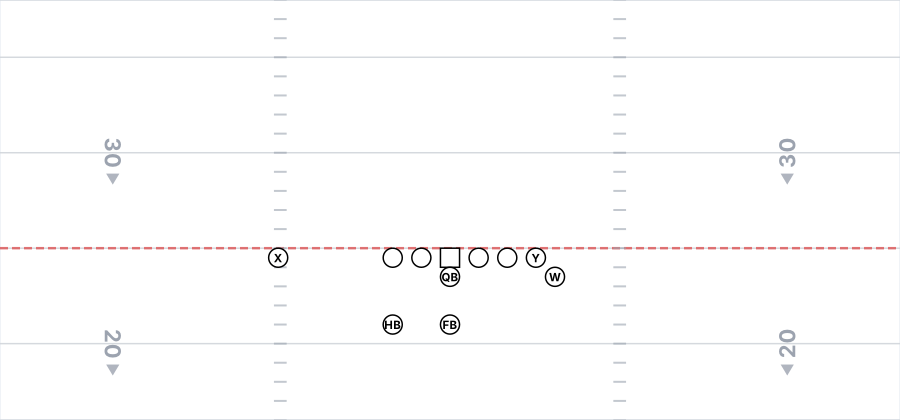
Rightthe base look: tight end and wing to one side, split end away, fullback behind the quarterback and a halfback offset 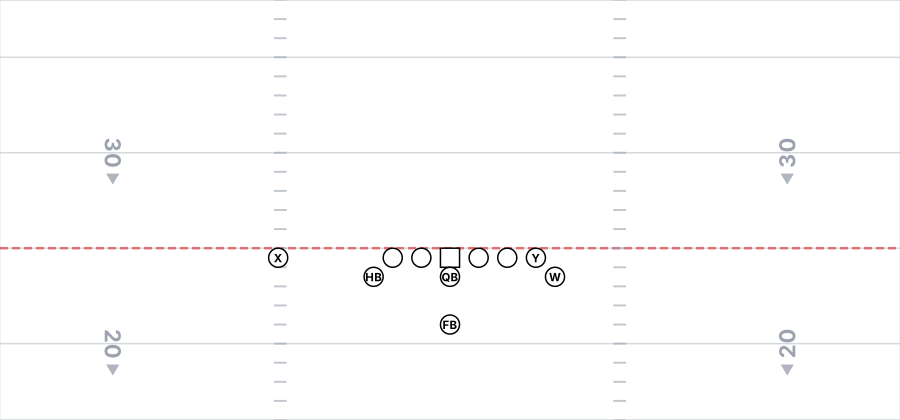
Double wingthe halfback moves out of the backfield to a second wing, which is where the formation gets its name
Signature plays


Anatomy of a play call
Not established yet. This section is left blank on purpose rather than filled with a plausible guess, and it stays blank until somebody can point at a source or a coach.
Origins, and what it borrows
The Wing-T inherits from both sides of its name. From the T, a fullback attacking downhill and three backs who can all carry. From the single wing, pulling linemen, angle blocking and misdirection.
Who has run it
- Dave NelsonMaine, then Delaware, 1949 to 1950 at Maine, 1951 to 1965 at DelawareHis Hall of Fame citation puts it in one line: "He started the wing T formation at Maine and developed it to its highest efficiency at Delaware." 105-48-6 as a head coach. Generally credited as the originator of what became the Delaware Wing-T, though every source says developed rather than invented, and there is an earlier claim below.
- Tubby RaymondDelaware, 1966 to 2001Was Nelson's BACKFIELD COACH before he was his successor, so he helped build the thing he later ran: his Hall of Fame citation says he "was instrumental in the implementation of the Delaware Winged-T, an offense that was adopted by thousands of high school and college teams." Then 36 seasons of his own at 300-119-3, with a national championship in 1971, an undefeated title in 1972 and a Division II championship in 1979. If the family has a flagship college program, it is this one.
- Otto D. UnruhBethel (Kansas), as early as 1938Called a formation he termed the T-Wing, which one source gives as the roots of the Wing-T. Predates Nelson's work by over a decade, which is the sort of claim a family's own coaches usually do not know about.
- Rich ErdelyiCarnegie Mellon, offensive coordinator from 1986, around 28 seasonsBuilt Carnegie Mellon's offense out of the Wing-T across nearly three decades, and developed his own named version of it, the Hybrid Wing-T, which he teaches publicly through clinic and video material. The most reachable living authority on this page: Nelson, Raymond and Unruh are history, and Erdelyi is someone a coach can actually go and learn from today.
- Forest EvashevskiIowa, 1952 to 1960Installed the Wing-T at Iowa and won Big Ten championships with it in 1956, 1958 and 1960, with the 1958 team named national champion by the Football Writers Association. He and Nelson had played in the same Michigan backfield under Fritz Crisler and later co-authored instructional books on the Winged-T. The clearest case of the offense working at the top level of college football rather than below it.
Resources
- BookThe Delaware Wing-T: An Order of FootballHarold 'Tubby' Raymond and Ted KempskiThe primary text, written by the coach who ran it at Delaware for 36 years. Out of print and easy to find used. Start here if you want the offense as its own program taught it.
- VideoHybrid Wing-TRich ErdelyiA current, taught version from the coach who ran it at Carnegie Mellon for nearly three decades. The most direct route to a living authority rather than a historical one.
- VideoWing-T offense video collectionMultiple coaches on individual concepts, useful once you know which series you want rather than as a first stop.
- Sitewingt-coach.comChris BrooksYouth-focused, single-coach site covering the install and how to attack common youth fronts. The closest thing to a free starting point for a volunteer staff.
Named systems in this family
- Delaware Wing-T
- DC Wing-T
- DC Pistol Wing-T
- Gun T
Related terms
- Double Wing
- single wing
- Gun T
- T formation