Single Wing Offense
also: Single Wing
A direct-snap offense that commonly uses an unbalanced line, extra blockers and a series of runs that look alike before attacking different gaps.
The traditional Single Wing looks unbalanced because it is. Set strong right, the line reads E-G-C-G-T-T-E from weak to strong. Both tackles are on the strong side, the strong end stays tight to the outside tackle, and the wingback aligns just outside and behind that end. The blocking back sets behind the strong guard.
The tailback and fullback give the center two nearby direct-snap landmarks. The play call determines which back gets the ball; the center is not making a choice after the snap. The Power, Sweep and Wingback Counter shown below all begin with the snap to the tailback, while the other backs lead, kick out or carry a fake. Balanced-line, spinner and spread-out variants also exist.
Beast offense, Wing-T, Double Wing, WildcatAt a glance
- Family
- Single Wing
- Level fit
- youth, middle school, high school
- Transfers from
- Beast, Wing-T, gap-scheme run gamesWhat carries over if you already run something else.
- Belongs to
- nobody. It is a family, not one coach's system
Who it is for
Single Wing makes sense when your best runner can take a direct snap but you do not have a conventional quarterback ready to run the offense. It gives that runner blockers without removing the possibility of a play-action pass. You still need a dependable center, backs who will block and carry out fakes, and linemen who can handle pulls and angle blocks.
What it asks of a roster
- A center who can deliver the called snap to either the tailback or fullback landmark
- A tailback who can carry the run game; the complete offense is stronger if he can also threaten play action
- A fullback, blocking back and wingback willing to block and sell fakes when they do not get the ball
- Linemen who can down block, pull and work double teams
What the staff has to be able to teach
- The unbalanced line: every player must know the strong side even though the center is not in the middle
- A repeatable left-or-right direct snap to the called tailback or fullback landmark
- Backfield timing that makes Power, Sweep and Counter begin alike
- The down blocks, kickouts, pulls and double teams attached to each play
Formations
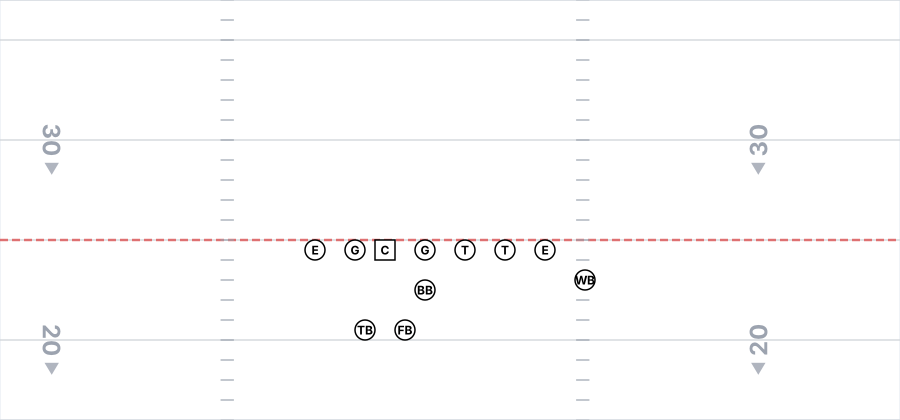
Unbalanced Single Wing (strong right)both tackles line up on the strong side, leaving the center visibly off-center in an E-G-C-G-T-T-E line
Signature plays


Origins, and what it borrows
Pop Warner wrote that his early single-wingback formation was often called the Carlisle formation because the Carlisle Indians first used it. After football's 1906 rule changes, the direct snap put the ball in a back's hands immediately, while the unbalanced line, pulling linemen and blocking back concentrated strength at the point of attack. Other programs copied and changed the alignment, and Single Wing became the broader name for the family. Modern youth and high-school versions keep those ideas while changing the formations and play calls.
Who has run it
- Glenn 'Pop' WarnerCarlisle Indian Industrial School, 1906 onwardDeveloped an early Single Wing at Carlisle (then commonly called the Carlisle formation) around a direct snap, an unbalanced line, pulling linemen and an additional blocking back.
- Charlie CaldwellPrinceton, 1945 to 1956Ran the Single Wing at Princeton; his 1950 team went 9-0.
- Rick DarlingtonApopka High School, modern high-school branchBuilt a modern power-series version and added contemporary answers, including RPOs, without dropping the traditional direct-snap structure.
Resources
- BookFootball for Coaches and PlayersGlenn S. 'Pop' WarnerWarner's own treatment of the offense and its formation, published in 1927 and now available in reprints.
- BookSingle-Wing Offense for Youth FootballJohn T. ReedA youth-focused installation covering personnel, practice, troubleshooting and a limited passing game.
- SiteCarlisle Indians Made It a Whole New BallgameProfessional Football Researchers AssociationThe traditional formation, backfield roles and the offense's early development at Carlisle.
- SiteRick Darlington's Single Wing Power SeriesWing-T Youth Football CoachA modern split-receiver branch with position profiles and detailed Power, Sweep and Counter rules.