Wing-T
A run-first offense built on down blocks, pulling guards and misdirection, with a tight end and wingback declaring a strong side. Plays are grouped and installed in series rather than one at a time.
2 meanings, all below. Jump to the one you heard.
Wing-T, The Offense
Structurally the Wing-T offense has a strong side with a tight end and wingback, plus a fullback and offset back behind the quarterback. The offense uses pulling guards, gap-scheme blocking and misdirection.
The classic Wing-T is a gap-scheme offense: linemen block down, pull or kick a defender out rather than stepping together through a zone. Many staffs teach some version of gap-down-backer: a lineman checks his inside gap first, then checks down the line for a defender over the teammate inside him, and if neither is present, releases to block a linebacker.
Buck sweep, trap and waggle are the buck series: the same backfield picture blocked three different ways.
Wing TDouble Wing, single wing, Gun TWing-T, The Formation It Is Named After
The name is the formation, in two halves.
The T is the backfield: the quarterback under center with backs behind him, which is the old T formation the family started from.
The WING is one of those backs moved up out of the backfield to stand off the end of the line, outside the tight end. In the classic formation, putting the wing beside the tight end creates another gap and makes that side visibly stronger before the snap.
You get numbers and blocking angles on the strong side, and you give up the surprise of where they are, so the misdirection has to buy back what the alignment gave away.
wing, wing alignmentT formation, single wingAt a glance
- Family
- Wing-T
- Level fit
- youth, middle school, high school
- Quarterback must throw
- some
- Quarterback decision load
- low (coach, offensive line)
- Borrows from
- T formation backfield, single wing misdirection and pulling linemen
- Transfers from
- Gap-scheme run games that already teach down blocks, kickouts and pulls, Double Wing packages that already use tight surfaces and angle blockingWhat carries over if you already run something else.
- Belongs to
- nobody. It is a family, not one coach's system
Who it is for
You do not need to be bigger than the team across from you. If your program draws smaller, quicker linemen, the Wing-T gives them blocking angles instead of asking each one to win a straight-ahead push.
The quarterback does not need to carry the offense as a passer. He does need clean footwork, because buck sweep, trap and waggle have to look alike at the start.
What it asks of a roster
- Two quick guards who can pull.
- A fullback who will run downhill and carry out the same fake when he does not get the ball.
- A wingback who can run, block and catch.
What the staff has to be able to teach
- Pulling technique for guards, taught as two different pulls: the flat kick-out and the deeper lead through the alley.
- The down block.
- Backfield mechanics: the ride, the fake, and footwork that looks identical across a whole series.
- Enough discipline in practice that players run their fakes at full speed when they know they are not getting the ball.
Formations
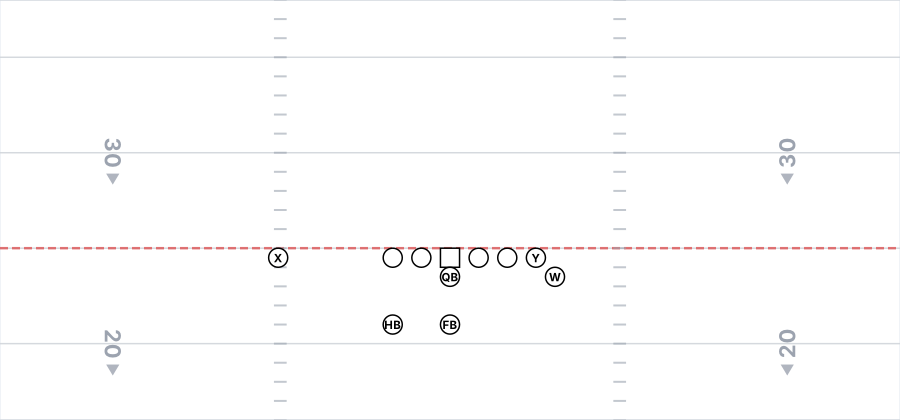
Rightthe base look: tight end and wing to one side, split end away, fullback behind the quarterback and a halfback offset 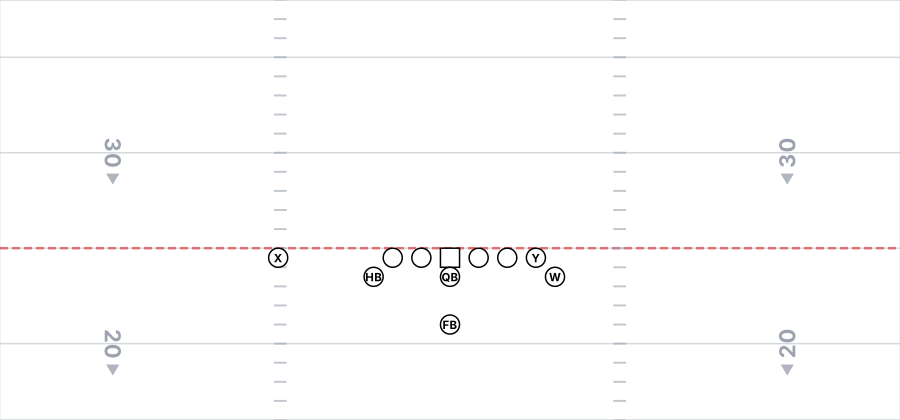
Double wingthe halfback moves out of the backfield to a second wing, which is where the formation gets its name
Signature plays


Origins, and what it borrows
A Maine staff led by Dave Nelson, with Mike Lude and Harold Westerman, developed the early Wing-T in 1950 by combining T-formation backfield action with single-wing blocking and misdirection. Nelson carried it to Delaware, where Tubby Raymond helped refine and spread it.
Who has run it
- Dave NelsonMaine, then Delaware, 1949 to 1950 at Maine, 1951 to 1965 at DelawareDeveloped the early Wing-T at Maine and carried it to Delaware, where the offense became identified with the program.
- Tubby RaymondDelaware, 1966 to 2001Helped implement the Delaware Wing-T as Nelson's backfield coach, then ran it for 36 seasons and won three national championships.
- Forest EvashevskiIowa, 1952 to 1960Installed the Wing-T at Iowa, won three Big Ten titles and was named national champion by the Football Writers Association in 1958.
Resources
- BookThe Delaware Wing-T: An Order of FootballHarold 'Tubby' Raymond and Ted KempskiRaymond and Kempski's book on the Delaware system. It is out of print but available used.
- VideoHybrid Wing-TRich ErdelyiErdelyi's video system on the Hybrid Wing-T he ran at Carnegie Mellon.
- VideoWing-T offense video collectionClinics from several coaches on individual Wing-T concepts.
- Sitewingt-coach.comChris BrooksYouth-focused articles on player selection, line play, formations and installing the offense.