Air Raid
A pass-first spread offense out of shotgun with four receivers and one back, no huddle, whose plays are built to spread a defense sideways, read single defenders, and punish light defensive boxes with a simplified ground game.
The Air Raid is a pass-first spread offense designed to stretch defenses across the full width of the field. It lines up in shotgun with four receivers and one back, usually two outside and two in the slot. It operates without a huddle, throwing on 65 to 75 percent of snaps.
Its passing concepts are built to get the ball out fast and let the quarterback read one key defender rather than diagnosing an entire secondary coverage. The core concepts work against man and zone coverage alike, allowing calls to stand at the line of scrimmage without complex audibles.
The ground game is radically simplified to act as an automatic mathematical constraint. By spreading four wide receivers, the offense forces defenses to remove defenders from the box. When defenses drop eight into coverage and leave five or fewer in the box, the quarterback checks to base inside runs. Extreme line splits of up to three feet widen the interior running lanes and isolate defensive linemen in one-on-one blocks, allowing the offensive line to run a productive run game while spending the vast majority of practice time mastering pass protection.
spread, aceAt a glance
- Family
- Air Raid
- Level fit
- high school, college
- Quarterback must throw
- yes
- Quarterback decision load
- medium (QB pre-snap, QB post-snap)
- Base formations
- Ace, Ace Rip, Early, Late, Blue, Green
- Day one install
- Mesh, Four verticals, Y stick, Inside zone
- Borrows from
- BYU's protection numbering, which Leach's playbooks reuse, quick-game concepts older than the family
- Transfers from
- A quick passing game you already teach. These concepts are older than the family that made them famousWhat carries over if you already run something else.
- Belongs to
- nobody. It is a family, not one coach's system
Who it is for
Everything here rests on the quarterback. He is picking the play as often as the sideline is: in one recorded season under Mike Leach, as many as 90 percent of the run calls came from an audible at the line of scrimmage.
The ground game exists as a direct mathematical constraint rather than an independent offensive phase. Hal Mumme and Mike Leach realized that four wide receivers force defenses to lighten the box. If the defense drops safeties and linebackers into coverage to leave five defenders in the box, five offensive linemen have a guaranteed one-on-one hat on every defender. The quarterback simply checks to Inside Zone or Draw.
The wide offensive line splits (often two and a half to three feet apart) serve both phases at once. In pass protection, they force defensive ends to rush along a wider arc, buying the quarterback clean sightlines and deep pocket depth. In the run game, the wide splits naturally expand the interior B and C gaps, isolating defensive linemen and eliminating the need for complex pulling or multi-level combination blocking.
That simplicity transforms practice economy. Because the offensive line only needs to execute one or two base run tracks (Inside Zone and Draw), roughly 80 percent of team practice time is spent perfecting pass protection, screens, and route repetitions (Mesh, Y-Stick, Y-Corner, and Four Verticals). Hal Mumme devoted five minutes every single day to drilling Mesh alone, and his coaches took twenty to thirty reps out of dedicated five-minute concept periods. A short playbook run a great many times, not a long one run once.
What it asks of a roster
- A quarterback who throws accurately and quickly, and does not hold the ball
- A quarterback who can count the box before the snap, and is trusted to check between run and pass at the line
- Skill players who are fast, agile, and disciplined in space
- Receivers who run precise routes, since the throw is timed to the break
- A running back who is an effective pass receiver and a decisive one-cut interior runner
What the staff has to be able to teach
- How to read the field: one fixed read per concept, taught so it survives a change of formation. One coach's mesh progression is the same five-step sequence out of 2x2 and 3x1 alike
- Teaching the quarterback pre-snap box counting: automatically checking to the run against five-man boxes and throwing against loaded boxes
- How to run a route against the way the defense has lined up, rather than running it the same way every time
- Operating without a huddle: getting the call in and the ball snapped from the line of scrimmage
- Protecting the quarterback and running inside zone out of line splits wider than most offenses use
Formations
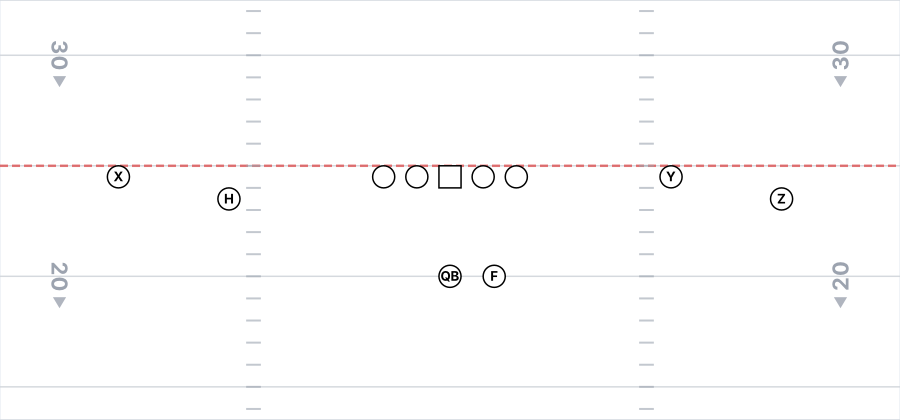
Acethe base set: four receivers, one back, two to each side, quarterback in the gun 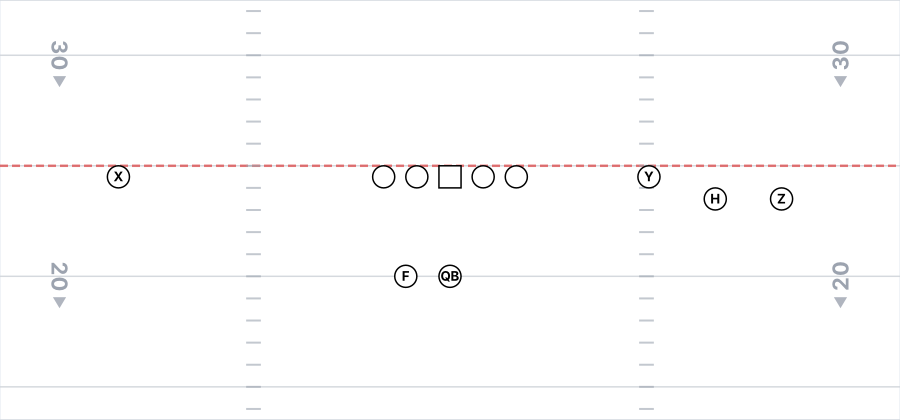
Earlythree receivers to one side: Early is trips right, Late is trips left, and either one is a single receiver crossing out of Ace
Signature plays
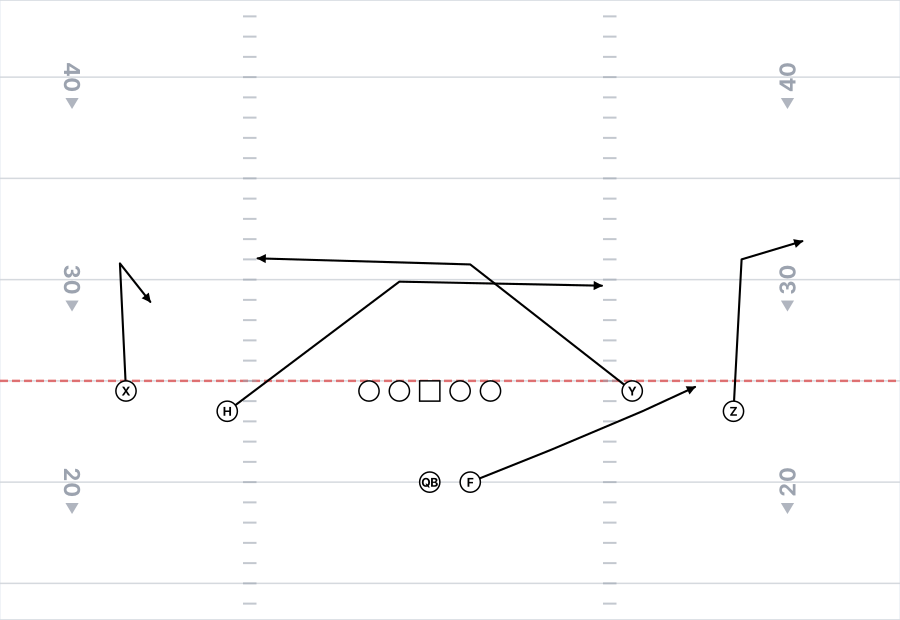
Meshtwo shallow crossers passing within a yard of each other, with an out and a flat underneath 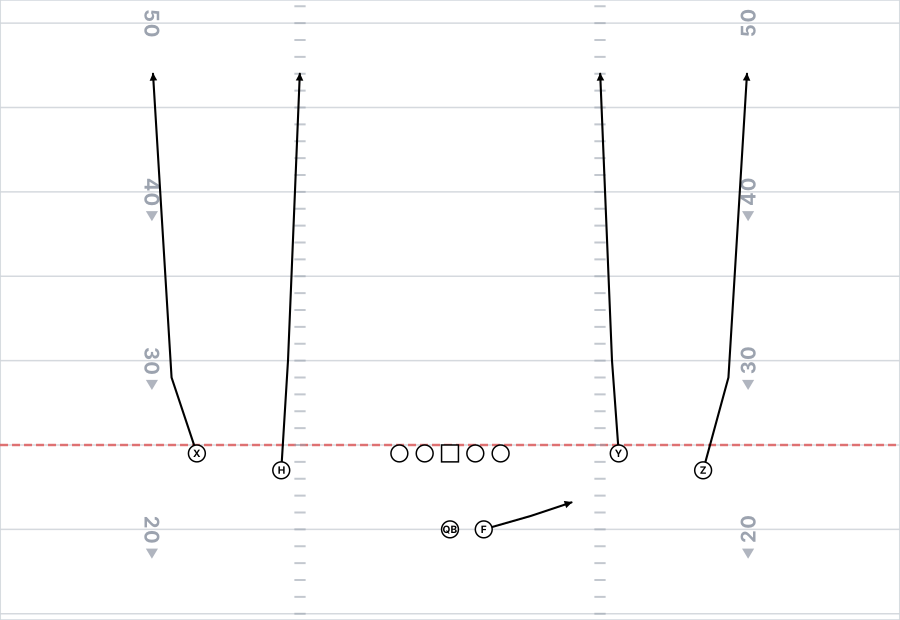
Four verticalsfour receivers to four deep landmarks 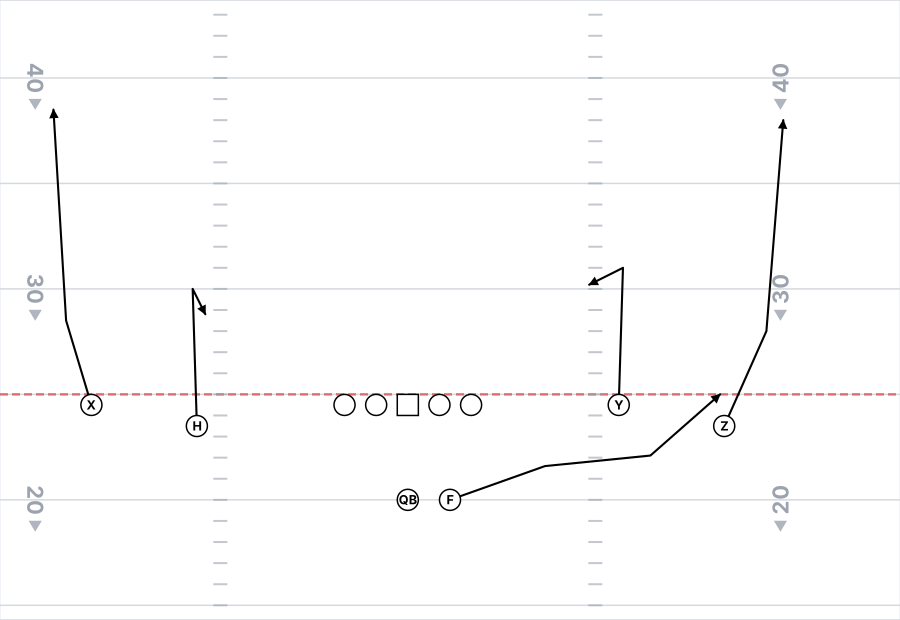
Y stickquick game that puts one flat defender in conflict 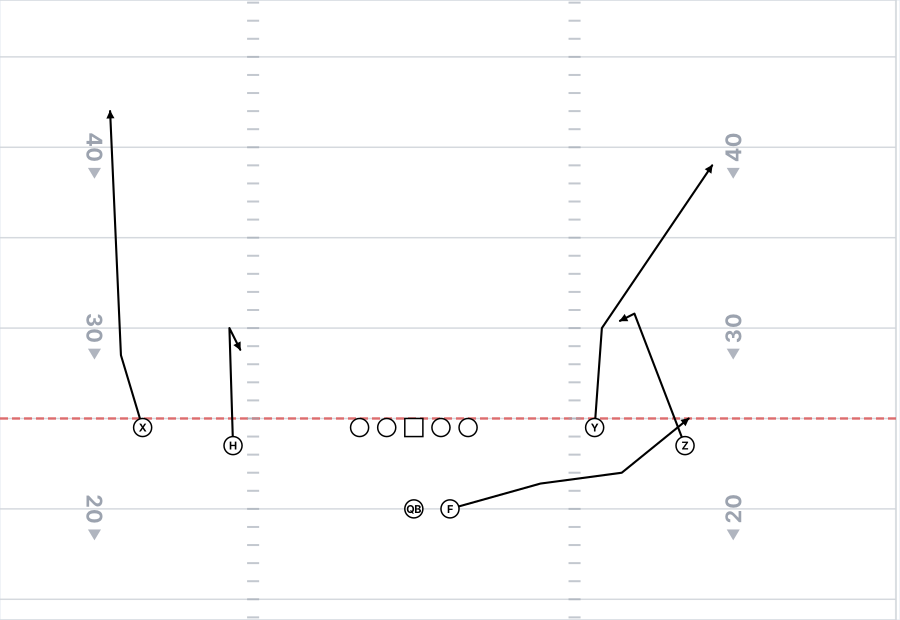
Y cornerplayside triangle: corner deep, snag inside, flat outside 
Inside Zonefoundational interior zone run with bang, bounce, or bend cutback reads 
Drawdelay run disguised as dropback pass protection to punish aggressive rushers 
Stretchperimeter zone run stretching the defense with 45-degree reach blocks 
Tunnel screenperimeter receiver screen where pulling offensive linemen form an escorted alley downfield 
Quick screenpre-snap box constraint throw out to the perimeter when defenses overload the box
Anatomy of a play call
A call is a formation, a number, and sometimes a tag on the end: "Early 92 Wheel". Early is the formation, 92 is the play, and Wheel changes one route inside it.
The number is doing two completely different jobs depending on whether the play is a run or a pass. Runs are numbered the way most of football numbers them, back first and hole second, even to the right and odd to the left. Mumme's 1997 Kentucky playbook prints the holes across the line as 9 7 5 3 1 0 2 4 6 8, so 26 Power is the 2 back through the 6 hole. Passes share none of that: in 92, the 9 is the protection and the 2 is the route concept. Hoover High School's playbook prints "90 PROTECTION" as the line rule on every page in the 90 series, and Leach's Oklahoma book contains exactly one protection page, titled "90 Protection".
The first digit stopped being a real choice, and that is the point of it. BYU's 1985 playbook numbers protections several ways. The Air Raid kept two, a quick series and a dropback series, and by 2010 a coach charting Louisiana Tech wrote that the protection on every pass was 90s. A digit nobody has to think about is a digit you can shout twice into a headset with no huddle. The number 617 is a protection at BYU in 1985 and a play in Leach's 1999 book: the digits made the trip and what they pointed at drifted.
Past that there is no shared code. 92 is Mesh in every Air Raid playbook read here and it is the only number that travels. 60 is "Out Routes" to Leach and "All Go" to Chris Hatcher. A coach who learns one program's numbers has learned one program's numbers.
What a call does not carry is a direction, because there is nothing to reverse. Mumme and Leach made the offense one-handed at Valdosta State, keeping Y to the right and X to the left rather than writing a left and a right version of everything, and they say Raymond Berry told them the Colts did it that way. The reason is teaching time: flip the formations and every receiver has to learn each route from both sides, and the quarterback has to learn to throw it to each of them both ways. When Leach did want a concept to both sides at Texas Tech, he did not flip anything. He wrote a second play and named it after the receiver who runs it, which is where H stick and H corner come from. It worked because Wes Welker was in the slot and still only lined up in a few places.
Origins, and what it borrows
Hal Mumme and Mike Leach built this offense at Iowa Wesleyan and Valdosta State in the late 1980s and early 1990s, and took it to Division I-A at Kentucky in 1997. The name came from a Valdosta State supporter who kept an air raid siren in the back of his truck and set it off whenever the offense scored.
Its older influences are less settled. The concepts predate the family: Y stick was already an established concept, and the vertical routes were not Air Raid inventions. The clearer inheritance is an approach rather than a play. At Valdosta they cut the playbook down and made the offense one-handed, and Mumme and Leach both credit that idea to a conversation with Raymond Berry about how he and Johnny Unitas did it in Baltimore.
Who has run it
- Hal MummeCopperas Cove High School, Iowa Wesleyan, Valdosta State, Kentucky, 1986 to 2000 across the fourNamed as one of the founders of the offense. He built the passing attack as a high school head coach at Copperas Cove from 1986, took it to Iowa Wesleyan, where his teams led the nation in passing offense in 1990 and finished second in 1989 and 1991, then to Valdosta State, then to Kentucky in 1997, which is where it reached Division I-A.
- Mike LeachIowa Wesleyan, Valdosta State and Kentucky as coordinator, then Texas Tech, offensive coordinator under Mumme through the 1990s, Texas Tech head coach 2000 to 2009Developed the offense with Mumme while Mumme was head coach and he was the coordinator, then ran it himself: Texas Tech "led the NCAA in passing yardage for four years in a row". He kept running it at Washington State from 2012 and at Mississippi State from 2020.
- Dana HolgorsenWest VirginiaOne of the assistants who left the Mumme and Leach staffs as head coaches and took the offense with them, alongside Chris Hatcher at Valdosta State, Art Briles at Houston and Baylor, Sonny Dykes at Louisiana Tech and California, Ruffin McNeill at East Carolina and Kevin Sumlin at Houston and Texas A&M. By 2016 seven of the top ten career passing percentage leaders in college football were Air Raid quarterbacks.
Resources
- BookKentucky 1997 offensive playbookHal MummeThe offense as Mumme handed it to his players, and the only one of the five playbooks read here that prints a key. Its Pass Offense page states what each series means, so it is the one document that explains the numbers rather than just using them.
- BookOklahoma 1999 offensive playbookMike LeachForty-three pages, one page per concept, from the year Leach was Oklahoma's coordinator. Page headers read "Blue Right 92 ( Mesh )", which is the whole offense in one line: the number is the call and the name is the gloss. No key and no glossary, which is its own lesson about how little this offense writes down.
- BookValdosta State 2000 offensive playbookChris HatcherThe same offense one program over, and useful precisely because it disagrees. Its 94 is X-Curl where Leach's is Y-Sail, its 60 is All Go where Leach's is Out Routes. Read it next to the Oklahoma book to see what a coach actually keeps and what he renames.
- SiteThe Complete Guide to the Air Raid OffenseScheme GuideThe best single piece of writing found on this offense. It is where the answer to why the Air Raid does not mirror comes from, why H stick exists, where the name came from, and what Mumme and Leach cut at each stop. Start here if you are reading rather than installing.
- Siteronmckiefootball.comRon McKieConcepts written up one at a time with the drill and the rep count attached. The most concrete free material on how to actually practice this, as opposed to what it is.
- SiteAir Raid Playbook seriesBrian Anderson, CougCenterA ten-part breakdown of Leach at Washington State, drawn from the 1999 Oklahoma playbook and from what WSU actually ran. Its formation post is where the four formation diagrams above come from. The live site blocks readers; the archived copies work.
A note on how the term is used
Rip is a modifier, not a side. It moves Y off the ball and Z onto it, which turns the base set into a mirror of itself. Other systems use Rip and Liz for plain right and left, so the word does not carry across.
Early is trips right and Late is trips left, and the mnemonic is the sound rather than the meaning: Late sounds L, Early sounds R. Colors name the two-back sets. Blue and Green are sourced, and the owner also recalls Tan and Brown. None of those are drawn here.
Mumme used Ace more narrowly than Leach did. His Ace has the Y attached to the line, and his word for the spread-out base set is Ace open.